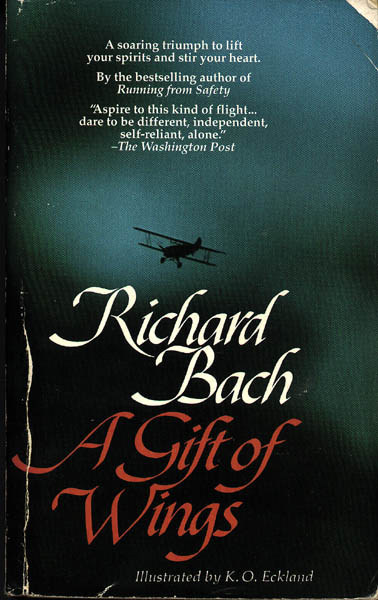
A
gift of wings
Girl
pichenette to the pilots having accumulated a little bit too much experience,
this history tells how three confirmed pilots, from whom Richard, arrive
at nightfall with the biggest difficulties to master their machine, then
wait, with anxiety, the arrival of their young team mate for novice. Which
was not their surprise to see the young pilot making a perfect landing!
They realized only at this moment that only him took the precaution of
observing the wind socket to land in front of wind, simply!
-
Found at
Pharisee and School of perfection
These
two novels follow each other and are rather characteristic of Richard Bach's
style. In the first story, a pilot very respectful of the aviation reglementation
(who speaks to the first person), is taken in hostage by an outlaw's band
of which the leader is certain Drake (I suppose that it is an allusion
to the famous English privateer Sir Francis Drake). These "bandits", in
spite of their weapons and their black clothes, commit the other crime
no than to plunder the technical archives of the FAA (American equivalent
of our DGAC), and to borrow, if need be, a plane and his pilot to be capable
of bringing back their "booty". Arrived in their "den", a cave filled with
planes, " outlaws " explains to our hero scandalized by their schemes,
which themselves they voluntarily put except the law to practise an aviation
without compromise with the mediocrity, and can not, or owe, to observe
an silly reglementation, even dangerous. Drake informs our hero, big defender
of the state of right, that, in spite of a maintenance completely corresponding
to the reglementation, one of the connecting rods of the engine is félée
and can break every minute. It would be so careful not to start again towards
the mountain, with a wind which strengthens and a ceiling which collapses.
Our pilot, taking refuge with the legality, leaves all the same. Once in
flight (under autopilot), he takes care of writing down the incredible
history which he has just lived. This text, found in the débrits
of its plane, and published in secret in an aeronautical magazine, ends
by the evocation of the difficulties that it meets during his flight, the
preparation of flight without visibility, then the engine stop...
In
" A school of perfection ", we find Richard, responsible for a flying school,
in search of a student who did not return. Navigating with the energy of
the despair and short petrol, Richard falls accidentally on Drake's mark.
As the previous pilot, he will collide in the, at least original, points
of view of the " outlaws " leader, he will even try to prove him that the
death of his student was inevitable. Then, discovering bit by bit Drake's
school, where to learn to fly can take a full life, he will accepted the
idea that the art of flying admits only perfection, and that money or reglementation
constraints can on no account justify that one admits that it is inevitable
to " lose " some students. Richard will return from it transformed, decided
well henceforth make his school working otherwise.
In
this story, Richard surrenders to an aviation meeting (certainly Oshkosh),
with three of his friends and three Piper " Cub ". On the way, they embark
hippies that were hitch-hiking. The exchange of points of view between
the pilots and the " freaks " is rather crunchy, but finally, they all
admit that, in spite of appearances, they are not so different...
-
A gospel
according to Sam
Richard
has the heart torn to be obliged to sell his old Ryan,
but he prefers to know that it flies rather than to see it rotting in the
back of a hangar. But he finds fast a manner to be comforted. In fact,
there are two parts in a plane : a part made with wood, with fabric, with
bolts and the other metal parts, and one other part, made by recollections,
by adventures and by feelings (seventeen forced landings in five years),
and this second part should not be sold, he owns it for ever...
-
Death in
the afternoon: a soaring story
It
will have been necessary for me not less of about ten readings to understand
finally the sense of this history. Subtlety lies in the fact that protagonists
take place aboard a single place glider aircraft. They are in fact the
two facets of the same person : Richard Bach. The characters of the one
and the other one are diametricaly different. The one that holds commands
is a exalted poet , impatient to feel free again, going back to his favourite
element : air. He is in a state of jubilation close to the bliss going
as far even as comparing every takeoff with a new birth. He is in no way
concentrated on his flight parameters and makes fun royally of the soaring
competition in which he is supposed to participate. The other person (conjugated
to the first person), is a killjoy procedurer, annoyed by the rigorous
lack of a flight instructor, seeing in the landscape arround only potential
dangers. Which is not the bewilderment when, after the takeoff, the poet
releases himself too much early from the towing cable, making so very weak
the chances to join the landing field. In this mountainous region, made
by lakes, by forests and by cliffs, any forced landing would be extremely
risky. Finding the providential lift becomes then a question of life or
death. The poet laughs at it and counts on his chance, while the other
one does not stand having only this solution. In spite of some minutes
of fear, everything will end happily ...
This
story reminds us that once in flight, we navigate all between these two
attitudes, and that it is not always easy to reconcile admiring beauties
of the sky and the total mastery of the machine...
-
Loops,
voices and the fear of death
Richard
evokes here difficult situations in which every pilot is brought to be
confronted one day: taken in the trap of a weather which degrades faster
than forecasted, involved in an autorotation of which it'is impossible
to get out, sucked down by downward wind in mountain... The only question
that one asks to himself at this moment there is always the same: " What
am I doing here? ". The answer which gives Richard is nevertheless simple:
" I am not somewhere else, I do live the present moment by fighting to
protect my life. Only moments as those are to estimate the real price for
it ". Going out from such situations give a victory feeling on elements
and on ourselves.
-
The pleasure
of their company
Richard
speaks about writers who urged him to push the doors of the sky and supports
the idea that it is not necessary to meet a writer so that he becomes friend.
It is enough to read his books ! he takes for example Antoine de Saint
Exupéry, who was already necessary to be able to perceive through
the thick cloud of smoke of cigarette which surrounded constantly his head.
Those that knew him confidentially, dreaded so much that he'd speak about
his health that to wait for the return of one of his flights by wondering
if he would think of taking out his landing gear. Richard Bach claims what
is more there are all the chances so that the German pilot who has shot
him down without suspecting, naturally which was his target, possessed
at his home (bombed by the allied) all the Saint Ex's books.
Richard
speaks here about his friend " Bo ", his winger during time he was a fighter
pilot. Of return in the civilian, Richard had continued to fly and to live
on pilot's profession, but Bo worked during ten years in a washing machines
company. Of their brief meeting which they had during this period, Richard
keeps only a bitter recollection to have seen that his friend had fled
the sky and had been mortified by the routine of a profession and a life
uninteresting. None of both tried afterward to keep in touch, until this
day when Bo, taking charge henceforth of a light passenger aircraft company,
invited Richard to come to spend some days. This new meeting does not look
like the previous one. This time this, two friends meet themselves really.
Contents